Showing posts with label puddings. Show all posts

Saturday, December 31, 2011

Raspberry Pâté


At some point during the holiday season, I lose all my will to bake. That's usually after I've baked the 11th or 12th batch of cookies. Family and friends no longer want to look at cookies, much less eat them. In fact, we've often already done our overeating before the actual holidays arrive.


 And yet, somehow, this Wednesday between Christmas and New Years, I decided I'd make a feast just for the family. I got a fancy roast from the butcher, made a gratin and sautéed wild mushrooms and cooked green beans. And I made this raspberry pâté.


There are two difficult aspects to this dessert, and you see the first above. You've got almost 2 pounds of raspberries that you need to force through a strainer. That takes a lot of patience and wrist strength.


 The second is the gelatin aspect. I still haven't figured out the gelatin/agar-agar thing, and the strange mushiness of this dessert is probably testimony to my lack of skill. Still, I consider it a success since I was able to actually cut slices of this rather than serve it in soup bowls.


 So, this is a sort of very rich gelatin dessert, with both cream cheese and whipped cream. It has intense raspberry flavor and isn't too sweet or rich. We all liked it a lot, except that Sami requested we not call it "pâté" since that name is in fact a bit off-putting for a dessert. He suggested "sliceable pudding", which still needs a bit of work, in my opinion. Maybe Bavarian cream cheese?


With the raspberry sauce and whipped cream, it's quite the elegant and festive dessert to serve after an elegant and festive meal--or just if you feel like having something special as you recover from the holidays. Here's to a great 2012! 

And here's the recipe:

Raspberry Pâté

30 oz. frozen raspberries in syrup (or 30 oz. raspberries and about 1/2 cup sugar), thawed
1 envelope unflavored gelatin
1 c. (8 oz.) whipping cream
8 oz. cream cheese, room temperature
1/2 c. (3.5 oz.) sugar
Pinch salt
Juice of 1 lemon

Very carefully line a 6-cup loaf pan with aluminum foil (in hindsight, if you have a silicone mold, that might be the way to go here.). Don't let it tear like I did, or you'll have the same mess on your hands that I did. Put a strainer over a large bowl. Pour the raspberries and syrup (if you mix the raspberries and sugar before they thaw, a syrup will form) into the strainer. Before you start pressing down on the raspberries, pour out 1/2 cup (4 oz.) syrup. Pour 1/4 cup of that syrup in a small bowl and sprinkle with gelatin. Let sit while you work to force the raspberries through the strainer. I find a food mill unfortunately lets through far too many seeds to work well, so the strainer it must be. Put an interesting podcast or some good music on and grit your teeth. Make sure you scrape the bottom of the strainer well. Let that sit while you do some more prep: Whip the cream to soft peaks in a smallish bowl and refrigerate that for a bit. In the large bowl of a mixer, beat the cream cheese, sugar, salt, and lemon juice until light and fluffy. Beat in the hard-won raspberry purée. Mine looked kind of curdled, but it turned out OK in the end.
Remember the gelatin you had softening? Time to melt the gelatin. Heat a bit of water in a small saucepan: when you start to see steam and small bubbles, put the (heat-safe) cup with the gelatin in it; stir until it's dissolved. Carefully remove from the hot water and add the remaining 1/4 cup of syrup. Beat this into the cream cheese mixture.
Oops, this is the step I missed but you shouldn't if you want your pâté to set up better than mine: Put the bowl with the cream cheese mixture in a larger bowl of ice water and stir with a rubber scraper until it starts to thicken. It should be about the same consistency as the whipped cream you're about to fold in. When it reaches that consistency, remove from the ice water bath and fold in the whipped cream. Pour this mixture into the prepared pan. Cover with plastic wrap and let chill at least 6 hours or overnight. 

While it's chilling, you'll want to prepare the raspberry sauce. Brace yourself: it involves more raspberry straining. In fact, if you're more organized than I am, you could thaw an extra 10 ounces of raspberries (in syrup, or with an added 2-3 T. sugar) along with the 30 ounces for the pâté, strain them, and take out enough so that you have 1-1/2 cups of purée for the pâté and the rest for the sauce. In any case, once you've strained the raspberries, you're home free: just add a bit (1 t.) of kirsch or cassis or framboise if you've got it. Taste to correct sweetness and chill until you're ready to serve.

When you're ready to serve, first whip 1 cup (8 oz.) whipping cream with 1 T. powdered sugar and 1/2 t. vanilla (and/or a bit more of that kirsch/framboise/cassis). 

OK, now it's time to unmold the pâté. First get out the plate you want to serve on. Then dip the bottom of the pan in hot water (this is another step I neglected but shouldn't have). Put the serving plate upside-down on top of the loaf pan and then reverse the two so that the serving plate is now on the bottom. With any luck, the pâté should unmold easily. Peel off the foil and breathe a sigh of relief. Now cut the dessert into slices and plate prettily with a spoonful each of raspberry sauce and whipped cream. Feel fancy.


Tuesday, December 6, 2011

East Hampton Chocolate Icebox Cake


 Given the number of cookies I've been baking lately, this dessert can definitely be filed under "completely superfluous desserts". We didn't have any company or any excuse to share this. Good thing I have a cute little miniature springform to make half a recipe in.


So this is basically a classic chocolate mousse, raw eggs and all, with the added complication of gelatin (I tried the agar again, with mixed success. If you don't have a vegetarian in the house, use gelatin). I'm not really sure the gelatin is necessary because the chocolate will firm up nicely. What makes it an icebox cake is the ladyfingers surrounding it, which soften up (the only ladyfingers around here are the crunchy kind; I imagine the kind you can get in the bakery section in the US would work better) and make a nice textural contrast with the mousse.


You're supposed to serve it with whipped cream, but when we were ready to eat it, I was not ready to make whipped cream. It would have been nice, but I don't think it's absolutely necessary.

I'll hand the verdict over to Julia. While she was retreating to her room with a large slice to accompany her through her many hours of homework, she told me, "This is the best thing to happen to me all day." I guess it wasn't superfluous after all.

Here's the recipe.

East Hampton Chocolate Icebox Cake

6 oz. ladyfingers (about 40)
7 oz. semisweet chocolate, chopped
9 oz. milk chocolate, broken up
1/2 t. plain gelatin
1 t. cold water

6 large eggs, separated
1/2 t. vanilla
1/4 c. Grand Marnier or Cointreau
Pinch salt
1/4 c. (1.75 oz.) sugar

Get out a 9-inch springform and line it with ladyfingers. You can do it as I did in the picture above, but I think Maida wants you to line the sides with the ladyfingers lying horizontally. Of course, that would be impossible with the crunchy ladyfingers...

Melt the chocolate: put the semisweet chocolate in a microwave-safe bowl and microwave 30 seconds. Add the milk chocolate and microwave another 30 seconds. Stir and see if it needs a bit more melting: mine needed another 15 seconds, but I have a weak European microwave. When it's all melted, set aside. 
In a small bowl or custard cup, sprinkle the gelatin over the water and let sit while you beat the egg yolks.
In a medium bowl, beat the egg yolks at high speed until they are pale and thick. Stir in the vanilla and about one-third of the Grand Marnier; let stand. 
Put some hot water in a small saucepan, put the custard cup in the pan, and place over low heat. Stir with a knife until the gelatin has melted. Then add the hot gelatin all at once to the egg yolk mixture, beating at high speed. Now beat in the melted chocolate.
In a large bowl with clean beaters/whisk attachment, whip the egg whites and salt at high speed until they hold a shape. Reduce the speed a bit and gradually beat in the sugar. Increase the speed again and beat until the whites hold a definite shape. Fold about a third of the beaten egg whites into the chocolate mixture, and then fold the lightened chocolate mixture into the egg whites. Pour this mousse into the ladyfinger-lined springform pan. Cover the pan loosely with a paper towel and then tightly with plastic wrap. Let chill at least 6 hours. When cutting into it, have a tall glass of hot water handy to dip the knife in so that the mousse doesn't stick to the knife. Serve with whipped cream if you'd like. This is supposed to serve 8-10, but it's so rich that it would probably serve more. 

Sunday, October 23, 2011

Hot Chocolate Mousse


Last weekend gave me the perfect opportunity to make this cake/pudding: we were having Sami's cousin and her son over for Saturday lunch. Sami's cousin is a high school teacher with a lot of personality; her son is her perfect comic foil, with deadpan delivery. We had a lovely long meal with interesting conversations about trade in 19th century Britain and how Tunisians would react to vegetarianism, for example.


I knew this would be a perfect dessert to make for this woman because she loves chocolate. She had hunted down the best chocolatier in Saint-Germain-en-Laye before we moved here, and when we brought her a box of my favorite chocolate, she got excited like a child at Christmas. My kind of dinner guest.


There are a lot of aspects of this recipe that make it great. For one, it's quite simple: once you've separated your eggs, you're home free. You can also make most of the recipe a few hours ahead of time and then finish it and put it in the oven right before you start your dinner. It doesn't fall like a soufflé, so it doesn't matter that you've barely gotten to the cheese course when the cake is ready to come out of the oven.


And let me just say that this is the perfect kind of dessert for a silicon pan like this: I'm not sure whether the cake would have unmolded from a regular Bundt pan.


And the verdict? It was light, fluffy, and very chocolate. It was more a cake than a mousse, really, but with whipped cream, it was a really excellent end to a fun meal.

Here's the recipe. Make it for chocolate-loving friends.

Hot Chocolate Mousse

5 oz. unsweetened chocolate, chopped relatively fine
1/2 c. (4 oz.) butter, room temperature
1 c. (8 oz.) boiling water
8 eggs, separated
3/4 c. (5.25 oz.) sugar
(optional: about 1/2 t. vanilla)
Pinch salt

If you're going to bake the cake right away, heat the oven to 350. Get out a Bundt pan and a baking pan (probably a 9x13 pan) that can hold the Bundt pan and some water. Butter the Bundt pan, even if it's nonstick, and sprinkle it with sugar.
In a medium bowl or glass measuring cup put the butter and chocolate. Add the boiling water and let stand for a minute or two. Stir until smooth. If it's not quite smooth, give it 30 seconds or so in the microwave. Let cool and then freeze for 15 minutes until quite thick. Whisk well and set aside.
In another medium-large bowl put the egg yolks and beat then just until mixed. Gradually add 1/2 cup (3.5 oz.) of the sugar (and the vanilla, if you want) and beat at high speed until thick and pale, 10 minutes (mine didn't take quite that long to reach that stage). Gradually fold the chocolate mixture into the egg yolks. You can let this sit for a couple of hours now if you need to.
Add the salt to the egg whites in the big bowl of a mixer (with a whisk attachment) and beat until they start holding a soft shape. Turn down the mixer and gradually add the remaining sugar. Turn the speed up and beat until the whites hold a stiff peak. Gradually fold the egg whites into the chocolate mixture.
Pour the mousse into the prepared pan--pour into one side and then into the other. Carefully smooth it out. Put the Bundt pan in the larger pan. Put the pan in the oven and then carefully pour hot water into the large pan until it's about 1 inch up the side of the Bundt pan. Bake for 45 minutes (check after 30 minutes and cover with foil if the cake seems too dark).
Remove cake from the oven and then the water-filled pan; let stand 5 minutes. Then reverse onto the serving platter but do not remove the cake pan. Let stand for 15 minutes, then remove the pan. While the cake is standing, make some whipped cream:

1 c. whipping cream
2 T. powdered sugar
1 T. each Cognac and rum (or Grand Marnier), or 1/2 t. vanilla

(The quantities given here are half those Maida gives. She probably likes whipped cream more than I do--there's always way too much.)
Put all the ingredients in a mixing bowl and whip until the cream holds a soft shape. I put the cream in the center of the Bundt ring, and it looked pretty. Eat soon and with gusto.

Wednesday, September 28, 2011

California Lemon Pudding


It would seem that after a nice long summer vacation, real life has finally kicked in--just in time for fall. This week involved a full day of volunteer work, a certain amount of editing, my full 15-hour teaching schedule, and a cold that started right around my second class of the day. Oh yes, and I baked.


I have a rather intense teaching schedule that involves two days of teaching six hours straight, plus a night class. It's pretty tiring while it lasts, but it does give me about 3 days off to do other things. And so I've determined I'll bake on one of those days.


This week I made the California Lemon Pudding, touted as being quick and easy as well as light and creamy and lemony. And indeed, it did come together in less than half an hour, right before I had to leave for a parent-teacher meeting.


So when we got back home, there was pudding (thanks to children who know how to take food from the oven, etc.)! That's definitely a nice weeknight bonus. 
The verdict? I liked this but didn't love it. The top layer is nice, like a light cake, but the pudding on the bottom was a bit too floury for my taste. Maybe it didn't chill enough. I also found it to be a bit too sweet. However, no one actually complained about it, and all 5 little cups disappeared rapidly. So I would recommend it, with less sugar, if you want something just a little special that comes together quickly.

Here's the recipe.

California Lemon Pudding

1 T. (0.5 oz.) soft butter
3/4 c. (5.25 oz.) sugar, divided (consider going down to about 1/2 c. or 3.5 oz.)
2 large eggs, separated
Grated zest of 1 lemon
1/4 c. (2 oz.) lemon juice (consider using more lemon juice in place of some of the milk)
2 T. flour
1 c. (8 oz.) milk

Heat the oven to 350. Get out about 5 custard cups and a large pan that can hold them and some water. Butter the custard cups and go ahead and put them in the pan. In a small bowl, use a hand mixer to beat the butter with 1/2 of the sugar (it will remain grainy, given the proportion of butter to sugar) until mixed. Beat in the egg yolks, then the lemon zest, lemon juice, flour, and then the milk, gradually. Wash the beaters and put the egg whites in a clean bowl with a pinch of salt; beat until they hold a soft shape. Add the remaining 1/4 c. sugar gradually, beating until the whites hold a fairly stiff shape. Gradually and carefully fold the egg whites into the lemon mixture. Pour the mixture into the buttered custard cups.
If you have an electric kettle, this is a great use for it. While you're making the lemon batter, heat up a kettleful of water. When all is ready and the water is hot, put the pan with the custard cups in the oven and then pour the water in from the kettle to about 1 inch up the pan. If you don't have a kettle, well, pour hot water into the large pan using your favorite technique. Bake for about 35 minutes (check after 25) until they are puffy and golden (see picture). Remove the cups from the water and let cool (they'll settle quite a bit). When they have cooled to room temperature, refrigerate them. Maida says they're best 3 hours after you bake them, if you can plan your day like that. You can either invert the custard cups onto plates and unmold these, or you can be less fancy and spoon them out of the cups. Guess which one we did? Celebrate that you have a little something for dessert.

Tuesday, June 21, 2011

Blueberries and Cream


Sunday was Father's Day, and we decided to do something nice for my father-in-law. Sure, he can be grouchy and controlling, but he means well. So we bought a lovely bottle of Bordeaux and brought over a bunch of food we thought he might enjoy eating. Sami went out into the cold rain (yes, it's June here--why do you ask?) and grilled a whole fish and some sausages (insurance against fish failure), and we had this potato salad (made with green beans instead of asparagus) and blueberries and cream.

And yes, I used frozen blueberries. France isn't really a blueberry kind of place. In season, you can get fabulous cherries and raspberries and apricots and currants...the list goes on. But the blueberries usually look sad and cost a fortune. These babies, from the frozen food store everyone loves to hate, are delicious and cost for a big bag what a tiny basket would cost at the market. And hey, I'm cooking them anyway.

This recipe is a keeper. It's like my favorite German dessert, Rote Grütze, which tends to involve lots of mixed red fruits: raspberries, cherries, currants, and the like. But the blueberry focus was nice here, and it seems so light and healthy and antioxidant-filled that it would be a shame not to put a giant dollop of vanilla-infused cream on top. So we went for it.
My father-in-law seemed very pleased with all that we offered him, so it was a good evening. You too will be happy to have made this very simple and delicious dessert.

Here's the recipe. Make someone happy.

Blueberries and Cream

2 T. (1 oz.) water
3 T. (1.5 oz.) lemon juice
1/2 c. (3.5 oz.) sugar--I used 3 oz. raw sugar, since I know the frozen berries are pretty sweet
Pinch salt
1 lb. blueberries, frozen or fresh
1/4 c. (2 oz.) cold water (you could use juice of your choice if you've got some lying around)
2 T. (0.5 oz.) cornstarch
About 1 c. (8 oz.) crème fraîche or sour cream
1-1/2 T. sugar
1 t. vanilla

Put the water, lemon juice, water, and sugar in a medium saucepan over medium heat. Stir until the sugar dissolves and the mixture begins to come to a boil. Add the berries, bring the mixture back to a gentle boil, and then turn down the heat and let them simmer for 5 minutes. In the meantime, mix the cold water and cornstarch to dissolve. Stir it into the berry mixture and cook over low heat, stirring gently and occasionally, for a few minutes to cook out the cornstarch taste. Don't stir too much and don't let the mixture come to a boil. Transfer to a bowl, cover, and refrigerate it for a few hours or overnight. While the mixture chills, at some point mix together the cream, sugar, and vanilla--all amounts are to taste. Serve the blueberries in bowls or wineglasses with cream on top.

Monday, June 20, 2011

Strawberry Yogurt Cream

There has been lots of cooking going on in my new kitchen, but not so much writing about it. I made this cream exactly one week ago to welcome Sami back from a short trip.

This dessert is one that I would classify as rather a fail. It was delicious (if not quite sweet enough!), but it didn't gel. I still haven't figured out how to work this agar-agar stuff. Everyone I've read about it says it works just like gelatin, but they lie, as far as I can see. On the other hand, look--ice! I have room to make ice in my new freezer!

Still--delicious strawberries in season, yogurt, whipped cream. Even though we drank it from the cups rather than unmolding it, we enjoyed this dessert--it was gone the next day. I just hope that by the time the next dessert involving gelatin rolls around, I've figured out how to make things gel.

Here's the recipe. Make it once you've mastered gelatin--or a substitute.

Strawberry Yogurt Cream
1 envelope unflavored gelatin
2 T. + 2 t. cold tap water
1 lb. strawberries, washed, hulled, and puréed (except for 6 pretty ones)
1/4 c. (1.75 oz.) sugar (or more--taste your strawberries)
Red food coloring, if you like
3/4 c. (6 oz.) unflavored yogurt--I used Greek
1 T. lemon juice
2 T. (1 oz.) dark rum or brandy (I bet something orange-y like Cointreau would be nice, too)
Pinch salt
1 t. vanilla
1/2 c. (4 oz.) whipping cream

Sprinkle the gelatin over the water in a small cup and let stand until it softens. Meanwhile, put the strawberries and sugar in a medium saucepan and heat until it just starts to boil. Off the heat, add the gelatin and, if you like, add a few drops of food coloring. Strain the mixture into a bowl and let cool down until kind of warm but not hot.
Whisk the yogurt, lemon juice, booze, salt, and vanilla into the strawberry mixture. Then place the bowl over a larger bowl filled about halfway with ice and water. Let cool and thicken, stirring occasionally. In the meantime, whip the cream. When the strawberry mixture is starting to thicken (and you're justifiably starting to feel quite superior to me), fold in the whipped cream. Pour the mixture into 6 small custard cups or whatever you'd like to serve the cream in. Refrigerate until cold and firm--Maida says you can also freeze them.
If these have worked for you, you should be able to unmold them onto plates and top with the pretty strawberries. If not, top the custard cup with a pretty strawberry and serve with a spoon--or a straw.

Saturday, April 16, 2011

Cream Cheese Flan

When we lived in Hattiesburg, we sometimes hung out with a couple from New Jersey, Bill and Luis. Luis teaches in the English department, and they have a beautiful house that they decorate to the nines, especially at Christmas. But in our minds, Luis, who is of Cuban origin, will always be associated with flan.

Luis would make flan for every get-together we attended, and there was never any left. He even made pumpkin flan for Thanksgiving, which was much more popular than the standard pumpkin pie. His flan was and is the standard by which to measure all flan.

So I was pretty excited to try this recipe, billed as a Cuban flan. Maybe I could recreate Luis's recipe in my own kitchen!

Um, no. But I blame myself, not the recipe. I didn't have the soufflé pan the recipe called for, and so I used a pie plate. I think that led to my having overcooked the flan, leading to it being more grainy than smooth and delicious. Mind you, it wasn't terrible and got eaten, especially served with a "red fruit" sauce, but this was not the flan of my dreams. I guess we'll have to invite Bill and Luis to visit us here.

Here's the recipe. Be careful with the temperature, and you may have more luck than I did.

Cream Cheese Flan

3/4 c. (5.25 oz.) sugar
8 oz. cream cheese, room temperature
3 large eggs plus 6 egg yolks
1 14-oz. can sweetened condensed milk
1 13-oz. can evaporated milk
Pinch salt
1 t. vanilla
Grated zest of a lime
Juice of same lime

Heat the oven to 350. Get out a 2-quart soufflé dish and a larger, shallow pan that the soufflé dish can rest in. Heat up a kettle of water.
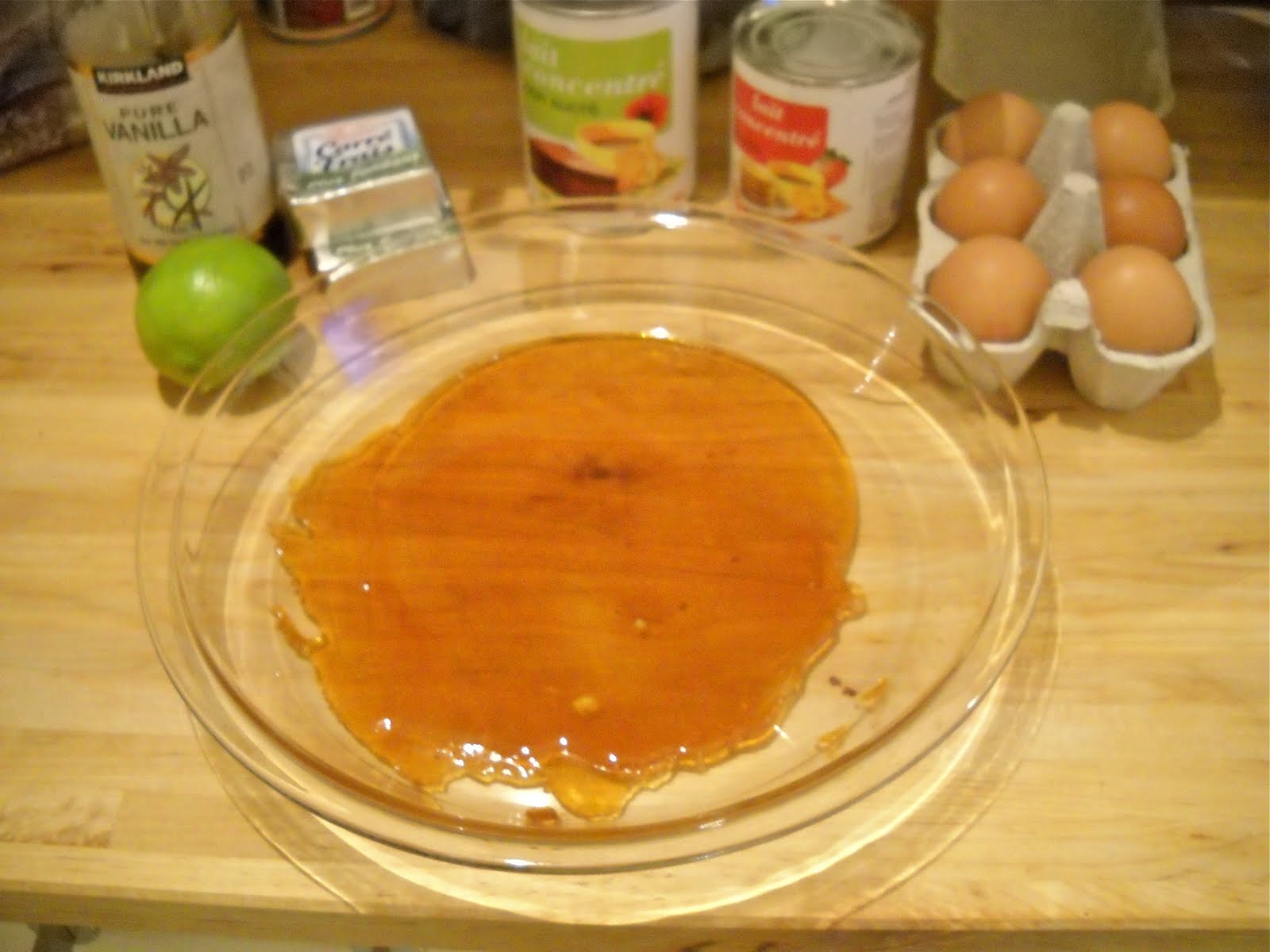
Put the sugar in a wide skillet over medium-high heat and stir until it starts to melt (it'll clump up; don't worry). Turn down the heat and keep stirring until the sugar is golden brown and smooth. Pour the caramel into the soufflé pan. Let cool a bit (the caramel will likely crack a bit, but no big deal). Butter the sides of the pan.
In a medium bowl, preferably one with a spout, beat the cream cheese until soft. Beat in the eggs one at a time, and then the yolks in several additions (2 at a time, say). Gradually beat in the condensed milk. Beat the mixture while you add the evaporated milk, vanilla, and lime zest and juice. Pour the mixture into the prepared soufflé dish. Put the dish in the larger pan and put both in the oven. Pour hot water into the larger dish until it comes about an inch up the side of the soufflé pan. Cover the soufflé dish with a cookie sheet. Bake for 1-1/2 hours or until a small, sharp knife comes out clean. You could also take the custard's temperature--175 is good.
Remove the flan from the pan with the water--careful! Let cool to room temperature, and then chill for 6-8 hours at least. Unmold at the last minute so that the caramel looks good.

If you want, serve with this sauce:

1 bag frozen raspberries (or mixed berries)
3 T. sugar

Mix the frozen berries with the sugar and let thaw. When it's thawed but still pretty cool, mash up the berries just a bit. Taste to see if the sauce is sweet enough.

Tuesday, February 8, 2011

Banana Pudding

We have this poster in our "water closet" right now; I'm not sure why. But it's a great reminder of the 10 years we spent in the South. This poster contains a lot of what we loved about the South: the quirky culture and humor (Southern Culture on the Skids has to be seen to be believed), the folk art (Dad got us this poster at the Kentuck Festival of the Arts, a reason for an annual pilgrimage to Tuscaloosa), and the food. My favorite Southern culinary invention: the vegetable plate. You get to choose four or five "vegetables", which might include macaroni and cheese, cottage cheese, or cobbler. Or banana pudding. (My favorite vegetable plate, for the record: collard greens, pinto beans, squash casserole, cobbler, cornbread. Mmmm...)

So I felt a bit nervous about recreating this Southern classic in my French kitchen. No worries, though--it's really just a kind of trifle, with vanilla wafers instead of cake.

About those vanilla wafers--strangely enough, they're not available here. So I used Petit Beurre biscuits, and they were perfect--they have that nice bland flavor and are sturdy enough to stand up to the pudding and bananas.

There are lots of variations on banana pudding: a lot involve Jell-o pudding and Cool Whip. That's another side of the South. Some involve meringue on top.


This one was simple: cookies, bananas, homemade pudding. No topping, whether whipped cream or meringue. Although the pudding took a while to come to temperature and all, it was really easy: I'm pretty sure I had this made within half an hour or so.


It's day old and bold, baby! We found that after a day, the bananas do indeed get "extra funky", so this is something you should make in the morning and consume all of in the evening. Or the next morning.

Here's the recipe. Enjoy a taste of the South!

Banana Pudding

1/3 c. (1.3 oz.) cornstarch
1/2 c. (3.5 oz.) sugar
1/4 t. salt
4 c. (I used a 1-liter bottle) whole milk
2 large eggs
2 T. (1 oz.) butter, cut into small pieces
1 t. vanilla
8 oz. vanilla wafers (you know, the yellow box) or a 200 g. package Petit Beurre
4 bananas, not too ripe

Get out a casserole or other serving dish that is fairly flat and shallow and holds at least 8 cups. Put a layer of about a third of the vanilla wafers on the bottom.
Now it's time to make the pudding. In a medium-sized, heavy saucepan whisk together the cornstarch, sugar, and salt; slowly whisk in the milk to avoid lumps. Put the pan over medium-low heat and bring to a boil, stirring just about constantly. This will take quite a while. While the milk mixture is heating, break the eggs into a bowl or glass measuring cup; whisk until well mixed. When the milk mixture has finally come to a boil, slowly and carefully pour about half of it into the beaten eggs, whisking all along (it's often good to have a helper when you're doing this). Then pour the egg mixture back into the milk in the pan and whisk that well. Put back over the heat and cook for 2 more minutes. The mixture will be quite thick. Off the heat, stir in the butter; when that is melted, stir in the vanilla. If you are worried about egg lumps, strain the pudding back into the bowl (washed or well scraped out) you mixed the eggs in.
Don't wait too long now: slice 2 of the bananas and spread them over the cookies. Pour half of the pudding over the bananas. Then repeat with cookies, bananas, pudding, and more cookies.
Cover with waxed paper or plastic wrap, pressed down on any exposed pudding if you don't like pudding skin. Let cool on your (cold) balcony or in your refrigerator for 4-6 hours and try to serve the same day. Easy on the teeth and gums!

Saturday, December 4, 2010

Wild Rice Pudding

When I was little, I used to be happy when there was leftover rice: Mom would almost always turn it into rice pudding. She'd spoon it into a casserole dish with some raisins (unless Alicia won the day), make a blender custard from the Joy of Cooking, and in the oven it went. Yummy--creamy, chewy, nutmeg-y.
She also sometimes made us custard or rice pudding when we were sick. So when Julia was home sick the other day, it seemed like a good time to finally make this wild rice pudding.

I was rather skeptical about the whole wild rice in pudding thing. Sure, wild rice is quintessentially American and all, but it's chewy and has that kind of grassy taste. Does it really belong in comfort food like rice pudding? I decided to make a half recipe, so as not to waste my precious stash of wild rice.

Julia helped with the food prep and photography. I let her portion out the raisins, and you can see she's overcome her raisin phobia.

The verdict? This would have made an awesome regular rice pudding. The custard is decadently creamy and delicious, but I found the wild rice's texture to be a bit off-putting. This is not to say, however, that these three portions of pudding did not disappear in record time. Julia ate hers while it was still warm. Claire ate mine, even though I protested that she wouldn't like it because it had raisins, in one rapid sitting when she came home from school. And Sami let me have a few bites of his later in the day.
This is not an everyday, oh-I-have-leftover-rice like Mom's standby recipe--it's a lot creamier and fussier, since you cook it before you bake it. But if you're looking for a luxurious custard with some chewy grain in it, look no further.
Here's the recipe. I'm giving you the full 6 portions.

Wild Rice Pudding

Generous 6 T. wild rice
1/4 c. light raisins (I bet you could use dried cherries or cranberries)
2 c. cream
4 egg yolks
1/4 c. sugar
Generous pinch nutmeg
Pinch salt
1/2 t. vanilla
1/4 t. almond extract

Rinse the rice and then cook it in a fairly generous amount of boiling water for about 45 minutes (or follow package directions); drain. The rice should be tender, and probably some of it will be split.
Heat the oven to 325. Get out 6 custard cups and a baking dish large enough to contain them. Divide the rice and raisins evenly among them. In a medium saucepan, heat the cream over medium heat until there are little bubbles around the side and it is starting to steam. While you're heating the cream, in a medium mixing bowl (or maybe a 4-cup Pyrex measure), whisk the egg yolks with the sugar, nutmeg, salt, vanilla, and almond extract. When the cream is hot, pour some of it slowly into the egg yolk mixture, whisking all the time. Then return that to the saucepan and cook, whisking, over fairly low heat until the mixture thickens some--Maida says it should reach 174 degrees. This takes about 10 minutes. Strain through a fine strainer into the custard cups. Ours curdled some but was fine after we'd strained it.
Put the custard cups into the baking dish. Very carefully pour boiling water into the baking dish so that it comes about one inch up the sides of the cups--it may be safer to do this when the baking dish is already in the oven. Bake for about 25-30 minutes, but check after 20. Give the baking dish a little jiggle. If the custards look liquid-y, then need more time. If they look solid or just have a minor jiggle, they're perfect. Very carefully remove the baking pan from the oven and then very carefully remove the custard cups from the hot water. Silicon potholders are great here because the cloth kind can soak up hot water--ouch! Maida recommends that you cool these to room temperature and then chill for a few hours. I tried Julia's warm pudding and Sami's cold pudding and I liked both. Enjoy these in good health.

Friday, September 3, 2010

Bread Pudding with Peaches

Back in February, I wrote about Maida's Apricot Bread Pudding, which I called the "Disappearing Bread Pudding". Well, score another winner for Most Rapidly Disappearing Dessert, right up there with the Boston Cream Pie. And by strange coincidence, Alicia and her family (or part of them, at least) were present for both events. Hmm...
The Apricot Bread Pudding, with all its dried fruit, was a really nice winter dish; this would be a perfect late-summer send-off for the last peaches and/or nectarines of the season. I didn't serve it as dessert, though--it was brunch. After all, it's just like peaches and French toast, right?
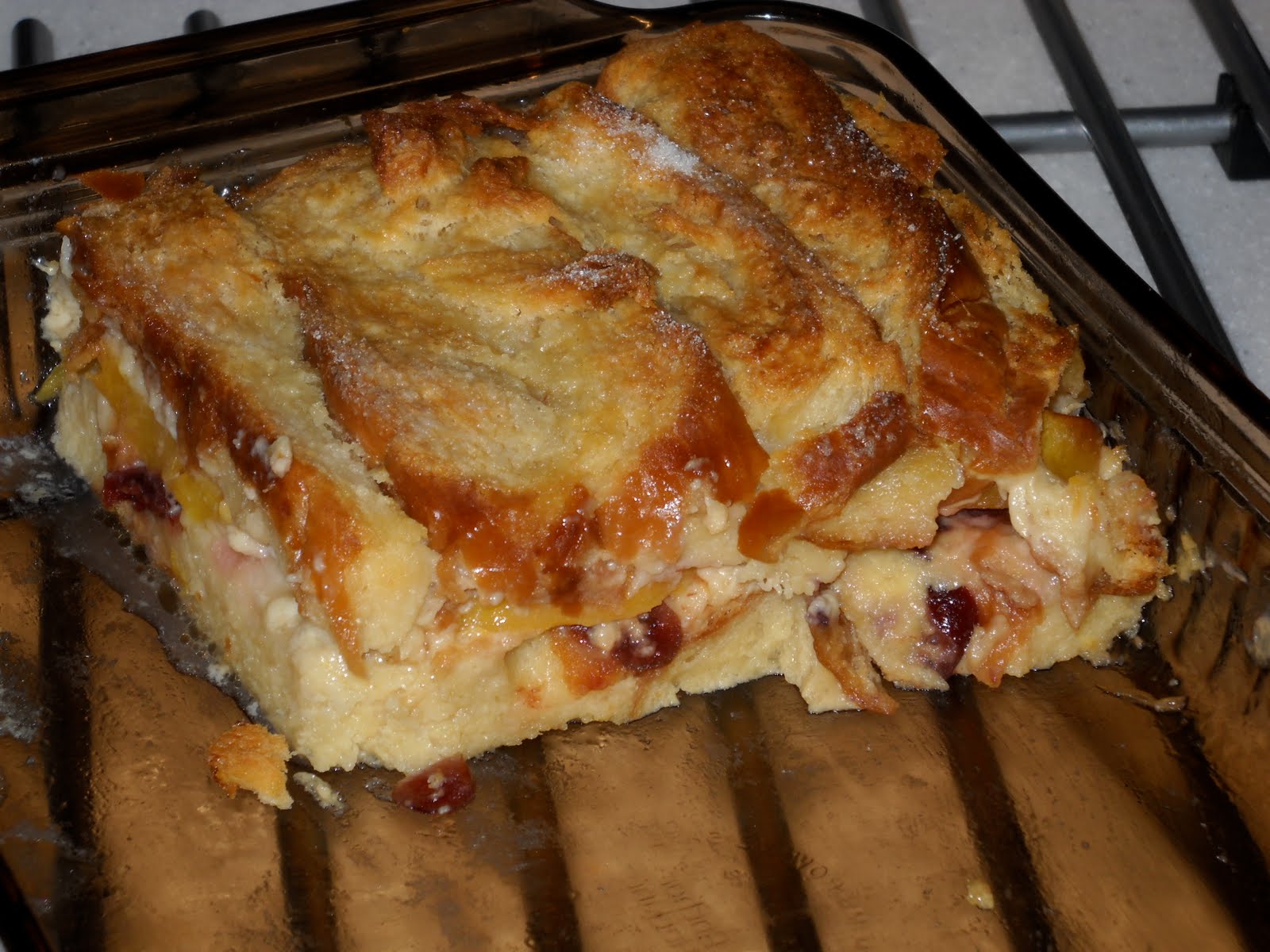
This is what was left in the pan about 15 minutes after it came out of the oven. You might say to yourself, "Hey, there are raisins in there! How did Maria ever get Alicia to eat raisins??" Well, they weren't raisins--at least not entirely. This was Trader Joe's Golden Berry Blend. It turns out that Alicia will eat any dried fruit that isn't a raisin.

And here's the pan after about 20 minutes. We had to roust Natalie from the shower to defend her last piece, and then Julia somehow convinced her to share that piece. Cousinly love.

Here's the recipe. It makes a great breakfast dish if you give yourself enough time for the 1 hour 15 minute baking time. I didn't, and we were all pretty darned hungry by the time we got to it. Perhaps that is part of the reason we fell upon it like a pack of wolves. Nah--it was really good.

Bread Pudding with Peaches

9-10 slices (about 8 oz.) white bread or challah, stale (leave it out on the counter for a couple of hours at least)
Softened butter
1/3 c. (1.6 oz.) golden raisins or other dried fruit that floats your boat
2 lbs. firm-ripe peaches or nectarines, peeled and sliced
1/2 c. (5 oz.) apricot jam (I forgot this and we put it on the finished product. Don't forget it.)
4 large eggs
1/2 c. (3.5 oz.) brown sugar
1/4 t. salt
1 c. milk
1 c. cream
3 T. rum (if you're channeling Maida, get out the Meyer's)
1 t. vanilla
1/4 t. almond extract
1/3 c. (2.7 oz.) cream
1/3 c. (2.3 oz.) sugar

I recommend starting this the night before you want to eat it, or at least 5 hours in advance. Get out a 2-quart baking dish and butter it. Now take the bread and butter one side of each slice. Stack up the bread and cut into about 3 fingers per slice. Make a layer of bread and butter on the bottom of the baking dish, covering it completely. Sprinkle the bread with the raisins. Now layer on the peaches--I didn't make my slices thin enough and they didn't entirely cover the bread. Slice yours nice and thin. Heat up the jam in the microwave for about 30 seconds and pour it over the peaches. You don't have to strain it. Cover all that with another complete layer of bread. If you don't have enough bread, butter and cut another slice. Now get out a 4-cup measure and pour in the milk and cream. Whisk in the eggs, sugar, salt, rum, and vanilla and almond extracts. You could do this in a blender if you wanted to. Pour that slowly over the bread and peaches--give it time to soak in. Now cover the pan with waxed paper and press down. If possible, put a couple boxes of brown sugar or something on top of the waxed paper before you put the whole thing in the fridge overnight or for at least 4 hours.
When you're ready to bake, heat the oven to 325 and get out a baking dish that will hold your bread pudding dish plus some water. Get the bread pudding out of the fridge and remove the waxed paper. Then drizzle the 1/3 cup of cream over it (it probably won't sink in because the bread is saturated) and sprinkle on the 1/3 c. sugar. Put the bread pudding pan in the larger pan, put that all in the oven, and then very carefully pour some hot water into the larger pan. Bake for a very long 1 hour and 15 minutes, until a knife inserted comes out clean. If the pudding still isn't as golden brown as you'd like, you could put it under the broiler. I didn't see the point.
Serve hot and prepare to fight over the last piece.

Monday, May 31, 2010

Mother's Spanish Cream

Another week, another party. That's how we roll here in Pontlevoy. Claire and I have decided that since we're stuck here (well, she feels stuck. I love it here!), we should make the most of it by spending time with friends. So on Friday we had a garden party with friends--some expats, some true Ponteleviens. One friend made a vat of sangria, others brought food--and Sami showed up just in time to man the grill so that we could have delicious lamb in pita. And then we had Spanish Cream.

This is a really nice warm weather dessert. It has a bit of oomph to it, but it seems light and cool and refreshing and goes well with fruit and whipped cream. But people weren't sure what to make of it--is it a cream? a custard? a flan? Well, I'm not sure myself. I saw a recipe for vanilla Bavarian cream that resembles this one a lot, except for the almond cookies and the egg whites. And I remember that there's a restaurant in Tuscaloosa that serves "Swedish cream" that's also pretty similar. I guess what makes this Spanish is the almond cookies.


Maida raves about the layering in this dessert: custard, then cookies, then fluffy egg white. Mine didn't separate all that much--the meringue especially wasn't much of a layer--but it was still delicious, and more important, GONE by the next morning. I like that in a dessert.
Here's the recipe. Make it for your next garden party or whenever you don't feel like turning on the oven.


Mother’s Spanish Cream

Dry almond macaroons like amaretti, to make 1/2 c. crumbs
3 c. milk, or half and half, or a combination
2 envelopes (or 5 leaves) unflavored gelatin
1/2 c. cold water
3 large eggs, separated
1/2 c. (3.5 oz.) sugar
1/2 t. vanilla
1/4 t. almond extract
generous pinch salt

Find a Jell-o mold or a silicone form; if you don’t have one, a big bowl would probably work. Also get out a medium saucepan, a medium bowl (the egg yolks can go in there), and a smallish bowl (the egg whites can go in there). Crush the cookies coarsely (put them in a Ziploc bag and pound them with a hammer) and set aside. Heat the milk in a saucepan over medium heat until scalding. While it heats, dissolve the gelatin in the cold water. Also, whisk the egg yolks with 6 T (3 oz.) sugar for a couple of minutes, until they are somewhat lighter in color. By this point, your milk should be nice and hot. Pour some of it gradually into the egg yolks, whisking all the while. Then pour the egg yolk-milk mixture back into the saucepan, return to medium-low heat, and heat to 180 or until the mixture coats the back of a spoon: the famous crème anglaise. Pour through a fine sieve back into the original bowl and add the vanilla, almond extract, and cookie crumbs. Set aside for a minute. Add the salt to the egg whites in the smallish bowl and beat them with an electric mixer until they are very foamy; then add the remaining 2 T/0.5 oz. sugar and beat until the egg whites hold stiff peaks. Ladle some of the hot custard into the egg whites and fold it in carefully, then pour the mixture into the egg yolk bowl and fold it together as best you can. It’s going to separate out anyway, so don’t worry if it doesn’t incorporate well. Get the Jell-o mold and run cold water over it; shake it dry. Now pour the cream in there and put it in the fridge for at least 3 hours.
When it’s time to serve, get out a basin or pan that’s bigger than your mold and fill it with hot water. Dip the mold in there for a few seconds, then cover it with a plate, turn it upside down, and hope for the best. Mine came out just fine.
Serve this plain or with fresh fruit and whipped cream.

Saturday, February 20, 2010

Apricot Bread Pudding

Being here in Pontlevoy is great for my baking experiments: the minute I've baked something, I can find many willing mouths to "taste-test" what I've done. I took a recent detour from Maida to make this and this (sometimes only chocolate will do). Both recipes disappeared in a flash. Sad to say, I had a hand in both disappearances.
But this bread pudding--well, I got to taste it. But that's pretty much it.


Sami and I are the Duke and Duchess of Chambord. What does that mean? Well, the Abbey has been divided up into four "houses" à la Harry Potter, and our house is Chambord. We meet with our students once a week to plan events and meals and generally discuss what it's like to live in France. And since I'm the Duchess, there are baked goods involved.
This bread pudding turned out to be perfect for our first group meeting. When I looked at the recipe, with all that cream and all those egg yolks, I knew we'd need help eating it. But I was a bit concerned that dried apricots and raisins would be "yucky" for picky college students. Never fear. When I brought it in, the students declared our house to be the best. Then they scrambled to get bowls, plates, etc. from the kitchen. Within minutes, a contented silence had fallen over the room. One girl was almost in tears as she contemplated her empty bowl. But everyone (except for Claire) was too polite to go for seconds. No problem there, either--Sami and Claire had a delicious breakfast the next morning.
This recipe is just as Maida describes--the tart apricots set off the bland, creamy custard perfectly. The almond extract adds a nice touch. And I wish I could have eaten one more piece.

Here are the ingredients. Note the size of the bread slices. I had to check on the Internet that an average slice of American white bread is about 1 to 1-1/2 ounces. Then I weighed my bread (half bakery bread and half supermarket bread, because that's what I had on hand). It was a lot more than 10 slices! Also notice that I used some "whole cream" (30%) and some "light cream" (15%). It turned out fine.

Mmmm...stacks of buttered bread. Can you tell the difference between the bakery bread and the supermarket bread?

Mid-assembly. The apricots look so nice against the white bread.

Fresh from the oven. The very brown parts are the heels of the bread. Waste not, want not.

Here's the recipe, if you've got hungry mouths to feed. Maida says it serves 8, but by my count, it served about 16.

Apricot Bread Pudding

6 oz. (generous 1/2 cup) dried apricots
1/3 c. (1.7 oz.) raisins, dark or golden
10 slices (about 12 oz.) good white bread, somewhat stale
About 3 oz. (6 T.) butter
2 c. cream (you can probably mix cream and half and half. Or just use half and half)
2 c. milk (again, you can probably adjust the fat content to your preferences)
5 large eggs plus 4 egg yolks
2 t. vanilla
1/2 t. almond extract
1/4 t. salt
1/2 c. (3.5 oz.) sugar, plus more to sprinkle

Get out a 13x9-inch baking pan (butter it) and also a larger baking pan that you can use as a bain marie (water bath). Snip the dried apricots into thin strips with scissors, then put them in a smallish bowl with the raisins. Pour boiling water over them to almost cover, cover with a plate, and let sit and soak for 20 minutes or so. In the meantime, get out the bread and butter. Butter each slice of bread fairly generously, stack the slices up, and cut them in half. When your dried fruit looks nice and plump, drain off the water. Now get out your buttered baking dish. Put in a third of the bread slices, buttered side up. Sprinkle them with the dried fruit. Repeat with another third of the bread, the rest of the dried fruit, and the rest of the bread. Maida suggests that you make sure that the top bread is arranged attractively. Maybe you shouldn't put the bread heels on top.
Now make the custard: Pour the milk and cream into a 4-cup Pyrex measure or another microwave-safe vessel. Heat for about 2-3 minutes or until steaming. In the meantime, put your eggs and egg yolks (save your egg whites in case you need to make fluffy white frosting someday...) in a large bowl and whisk them to blend. Add the vanilla, almond, salt, and 1/2 cup sugar, and then gradually whisk in the hot milk/cream. Slowly and evenly pour this mixture over the bread. Then put a piece of waxed paper or plastic wrap on top (I used parchment and the butter stuck to it) and push down the bread so that it all soaks up some custard. Let it sit at least 30 minutes; you could probably refrigerate this overnight and then bake it for a delightful breakfast.
Heat the oven to 325. Remove the paper/plastic from the pudding and sprinkle it with about 2 T. sugar. Put the baking dish in the larger pan. Put both in the oven and then VERY CAREFULLY pour hot/boiling water (I use my boiler for this) into the larger pan, avoiding the bread pudding. The water should be about an inch deep. Bake for about 40 minutes, or until a knife comes out barely dry. Serve hot or warm (or cold for breakfast). Be prepared to defend your serving (or second serving).
Maida suggests this might be served with some warm apricot jam thinned with rum or bourbon, which I did not do but would probably be delightful. If you try this, tell me about it.

Monday, November 2, 2009

Chocolate Pudding FAIL

I love chocolate pudding. I really do. I especially love German chocolate pudding. That is, the mix that you cook.

Yes, sadly enough, this is my favorite kind of chocolate pudding. I looked at the list of ingredients, and it's pretty much just cocoa, chocolate, carageenen, and some other flavorings and stabilizers. Not all-natural, but not that scary, either. You add your own sugar and milk (and I usually throw in a square or two of chocolate) and cook it up. I made this several times in the camper this summer, and it was delightful--chocolatey without making you feel like your arteries needed a Roto-rooter.
Now Maida's pudding, on the other hand, involves two kinds of chocolate, cocoa, cornstarch *and* eggs/yolks for thickening, and butter. It's pudding that's moving into pots de crème territory. And for me (and for Claire), that's just a bit too much.
As I write this, I know that when Alicia finally makes this recipe in December or something, she will swoon over it and tell us it's the best pudding ever. Whatever--I'll probably still have some sitting in my fridge. It's been two days now and I haven't been able to eat my way through one custard cup of it.
I'm equally sure that Alicia will tell me that I did something wrong to get the results I got. And I will admit to two issues--well, maybe two and a half. The first was that the semisweet chocolate I used was too strong--that 72% Trader Joe's bar that will not be used up. I upped the sugar a bit to compensate, but it really wasn't enough. The half problem may be that I didn't chop the chocolate well enough before I put it with the milk. The chocolate never really incorporated into the milk, and I now have tiny chocolate chips in my pudding.
The next problem was that after I had done the cornstarch and the eggs and all, I forgot about adding the butter and vanilla until after I'd already poured the pudding into cups.


Never fear--I just put little lumps of butter and a splash of vanilla into each cup and stirred it until melted. Except that there's now congealed butter on the side of each cup. Yuck.

Here's Claire's pudding, with powdered sugar on top. Still, she took two bites and put it back. "Too rich" was her verdict. Now Claire is not a big lover of rich desserts--she'd rather eat ice cream. But I agree with her. The awesome homemade applesauce I also made yesterday--that's something we both can't get enough of!

But if you love super-rich pudding and doing lots of dishes, here's a recipe for you:

American Chocolate Pudding

1 egg plus 2 egg yolks
Pinch salt
2 T. cornstarch
3 T. cocoa
4 oz. (1/2 c. + 1 T.) sugar
2 oz. unsweetened chocolate, chopped
3 oz. semisweet chocolate (I would stay at 60% cacao or under for this)
2-1/4 c. milk (I used whole; 2% would probably also be fine)
2 T. butter, cut into pieces
1 t. vanilla
(1 T. rum--this might be a nice addition to cut the sweetness. I forgot about this in my flustered state of mind)

Get out a saucepan, two medium sized mixing bowls, and an assortment of custard cups or whatever you're going to serve this in. I used 5 Pyrex custard cups because that's what was clean and available. Put your eggs in one mixing bowl and beat them to mix. Strain the cornstarch, cocoa, salt, and 2 oz. sugar into another mixing bowl, and whisk that together with 1/4 c. milk. Put the chocolate, 2 c. milk, and 2 oz. sugar in the saucepan, and heat to a boil over medium heat, whisking constantly. Maida says the flecks of chocolate will disappear as the milk heats, but this never happened to me. Maybe I was too afraid of the chocolate burning. When the milk has reached this stage, pour some of it into the cornstarch mixture, whisking as you pour. Then pour the cornstarch mixture back into the saucepan. Place back over medium heat and bring to a low boil, stirring and scraping with a heatproof rubber spatula. Turn down the heat and let it cook for about 2 minutes. Then get your bowl with the eggs and basically do the same thing with that: add some hot chocolate mixture to the eggs, whisk that, then add back to the saucepan and cook over low heat for another couple of minutes, stirring and scraping and being sure to keep it from boiling and scrambling. Now take it off the heat and ADD THE BUTTER AND VANILLA (and rum, if you want) before spooning it into the cups. Cover each cup with plastic or waxed paper, to avoid skin, and refrigerate. (There seems to be a movement for skin on pudding. David Lebovitz says there's no point in making pudding if you don't like the skin. Whatever.) After you've returned from a 2-hour hike, you may be ready for this.
Or see if you can find some nice Dr. Oetker pudding mix.